Welcome to another edition of Ms. Lu’s Library!
(Well, actually… this is the second take on the last edition of Ms. Lu’s Library.)
So, as a reader, you know how this typically goes…
You settle on your next book to read, start knocking out pages (and taking notes even), but THEN… then you come across a book that totally sidetracks you and your focus. Of course, before you realize it, the “planned read” is collecting dust on your bedside table because you are now completely engrossed in whatever new book you picked up to read in it’s place.
For me, this summer, it wasn’t just one new book – but TWO – that “snatched” my attention away from Happier at Home and sent my bookworm’s appetite into overdrive.
Before going on a work conference trip to DC in mid-July, my coworkers and I scheduled some group and individual sightseeing time to round out the week’s itinerary. For me, my primary focus revolved around visiting two specific Smithsonian Institution museums: one, a long-time favorite – the National Museum of the American Indian, and the other, a “new kid on the Mall” – the National Museum of African American History and Culture. Knowing I always gravitate to the book and music sections in museum gift shops wherever I go, I made sure to set aside some “splurge” money just for that occasion. And, like clockwork, I spotted multiple titles of interest… but settled my heart on these two.
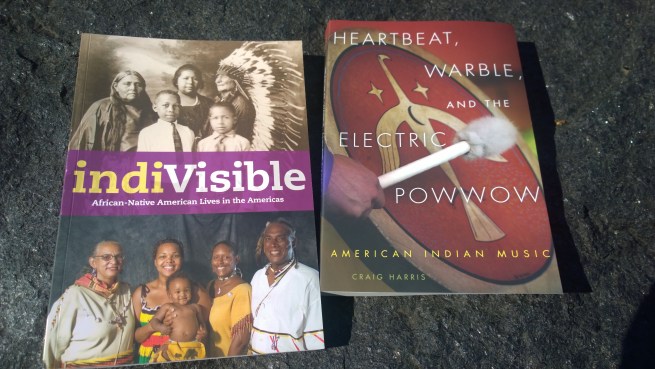
So, I’m gonna tackle sharing about these two books in the order I read them (right to left), which is not in the order they are pictured above (left to right).
***
Heartbeat, Warble, and the Electric Powwow by Craig Harris
Heartbeat, Warble, and the Electric Powwow: American Indian Music by Craig Harris immediately caught my eye because, as my other alter ego DJ Lady Luck would tell you, I L-O-V-E music! So, this book was purchased with the hope of learning more about artists I am already familiar with as well as possibly “discovering” artists I haven’t heard about yet. But what I found upon reading is that I had purchased a treasure that blended lessons on the history of human interaction, healing power of music, and the rich legacy of tradition -even when breaking away from it – among the indigenous peoples of this land/hemisphere.
The first paragraph or so of the book’s introduction best demonstrates what I mean:
“Christopher Columbus was exploring the coast of Trinidad during his third voyage to the ‘New World’ in August 1498 when he caught sight of a ‘large canoe of twenty-four [Native] men.’ Hoping to attract their attention, the once-lost navigator summoned for a tambourine and instructed members of his crew to play music and dance. When the Natives, misinterpreting the gesture to be a war dance, unleashed ‘a shower of arrows,’ Columbus responded by ordering ‘some crossbows to be discharged.’
This escalating exchange would not only exemplify the lack of understanding between European explorers and America’s First People, but also emphasize the seriousness of music among the Indigenous.”
Throughout Heartbeat, Warble, and the Electric Powwow, I found points of wisdom, universal truths, and instances where when many musical artists experienced a devastating or particularly rough moment in their lives, they found music (and the making of music) to be a force that brought them out of that dark time.
‘The sound of the Earth as it moves is what I equate percussion to,’ said Nakai. ‘If you meditate in a quiet spot, you can hear the Earth as it breathes. That is where, I believe, percussion sound comes from.’
-From Pg. 33, in section on R. Carlos Nakai (Ute/Dine)
Here’s another:
‘I saw trees thrashing around in a storm,’ she said, ‘being plummeted by rain, sleet, hail, and wind. They were really at the mercy of the elements. They were rooted in the ground, and they couldn’t go anywhere, but they seemed like they were dancing. I thought, ‘Aha, they adapt to the wind, maybe they like to have the rain brush off the dust, maybe it feels good to have the wind shake off those old limbs, maybe I need to learn how to bend and be more pliable during these tough storms in my life.’
– From Pg. 46, in section on Mary Youngblood (Aleut/Seminole)
And another:
‘I just knew, in my heart of hearts,’ Shenandoah said, ‘that it was my responsibility to put out music that was healing. The Iroquois believe that everyone on this Earth is here for a specific purpose. We all have a special gift that, if we use it in the right way, will make the whole world a better place. For me, it’s music.
– From Pg. 87, in section on Joanne Shenandoah (Oneida)
And lastly, this quote:
‘How could I know a song that well without having played it before? I came to the realization that it was a gift from the Creator. Through tragedy, good things come. For me, it was that gift of music, once again.’
– From Pg. 242, in section on Gabriel Ayala (Yaqui)
Heartbeat is divided into six sections:
- The Heartbeat (focused primarily on powwow drum groups, as well as the music heard during social and religious dances at gatherings)
- The Warble (explored artists of flute music, along with the music of other woodwinds and whistles)
- Tribal Voices (concentrated on Native singers, songwriters, and storytellers from all types of music genres)
- Rez Rockers, Guitar Heroes, and Rasta Men (self-explanatory, to include sections on Link Wray, Taj Mahal, Clan-destine, and Indigenous)
- Divas, Hip-Hoppers, and Electronic Dance Masters (self-explanatory, to include sections on The Village People, Jana Mashonee, Litefoot, and A Tribe Called Red)
- Depicting and Defying Stereotypes; Coda
To me, the last paragraph of the book is just as thought-provoking as the first. By sharing it here, I hope it’s one others will take to heart for themselves:
“After more than half a millennium of stereotyping, cultural suppression, economic poverty, forced assimilation, and urbanization, the music of Native America (like the people) remains invincible, continuing to burn with hope, promise, and determination. Isn’t it time that we listen?”
***
So, with the eagerness to learn and understand more on a topic I’ve not often seen published about, I easily devoured Heartbeat, Warble, and the Electric Powwow in a two-week period, starting my read while still in DC and finishing it by the end of July!
Which leads me to discuss my second book find from that trip…

IndiVisible: African-Native American Lives in the Americas
What makes indiVisible: African-Native American Lives in the Americas such a great addition to my library is it represents a collaborative project and exhibition between the Smithsonian’s National Museum of the American Indian and its National Museum of African American History and Culture – again, my two most favorite places (so far) to visit in our nation’s capital. As Gabrielle Tayac (Piscataway), general editor of IndiVisible, best sums up on page 19 in the last paragraph of her introduction:
“Ultimately, IndiVisible goes beyond its subject matter. All human beings express the basic desire for being and belonging. Revealing a particular aspect of this fact through the examination of African-Native American lives can help everyone to more deeply look into their own identities, origins, and the forces that make us who we are. May we all overcome with the power of love, not the love of power.”
In addition to the introduction, the book’s contents include a joint foreword from both museum directors, a closing poem titled “Bones and Drums” by Ron Welburn, and – in between the two – essays from contributing writers that are grouped into these categories:
- Race and Policy
- Community
- Creative Resistance
- Lifeways
Sooooo much historical and cultural juiciness can be found in the pages of indiVisible that it’s hard for me to know exactly where to begin in my take on what I learned from this read. Therefore, the best way I can think of summing it up is to pull out some passages that really spoke to me or helped shed some light on me better understanding my family’s mixed heritage.
In the conclusion to Angela A. Gonzales’s (Hopi) essay titled “Racial Legibility: The Federal Census and the (Trans)Formation of ‘Black’ and ‘Indian’ Identity, 1790-1920,” I found this passage most informative:
“By dividing people into official governmental categories, the census gives legitimacy to the categories themselves and to this mode of thinking… The realization that governmental statistics gathering and census taking have been influential in creating and manipulating identities requires an understanding of the evolution of the census enumeration process and the role it has played in constructing American Indian and African American individual and collective self-understanding and identity.” [Pg. 67]
Next up is an excerpt from Kimberly Tallbear’s (Dakota) essay titled “DNA and Native American Identity.” And, as someone who always tries to imagine the thoughts, reasons, and emotions behind how life played out for groups of people throughout the course of time based on my understanding of how life currently plays out for people in this time, Tallbear’s comments on genetic tests, markers, and databases make total sense to me from my observations of those same patterns in human behavior:
“Genetic ancestry tests involve assumptions of uncomplicated social continuity between present-day ethnic/national/racial groups and groups in the past, even if those groups are genetically related… Genetic markers come to stand for the individual and the race, group, or tribe. Patterns of residence today, however, are rarely synonymous with patterns of the past. Human beings move around. Social groups organize themselves and are organized, and name themselves and are named, in different ways from era to era. Genetic databases built from living human beings’ biological samples offer interesting but incomplete genetic views of the deep past and certainly should not be seen as anything approximating a cultural or social snapshot.” [Pg. 71]
One essay surprisingly shed some new light on a very important piece of history – the Underground Railroad – and its “unknown to me” connection to my own heritage puzzle. Titled “Rotihnahon:tsi and Rotinonhson:ni: Historic Relationships between African Americans and the Confederacy of the Six Nations,” this essay was written by Richard W. Hill, Sr. (Tuscarora), an artist, writer, curator, and professor who teaches at the First Nations Technical Institute (FNTI) in Tyendinaga Mohawk Territory, Ontario.
“The escape routes followed ancient Indian paths connecting the Tuscarora Territory of North Carolina to the lands of the Seneca, Cayuga, Onondaga, Oneida, and Mohawk nations in New York State. The Warrior’s Path and the Forbidden Path served as woodland expressways for hundreds of warriors, countless bundles of trade goods, and an unknown number of fugitive Rotihnahon:tsi [the Mohawk name for African Americans, meaning “people who have dark skin”].
The Tuscarora were engaged in contentions with colonists and other local North Carolina tribes. Competing trade interests contributed to conflicts with other Native nations, but colonial records show that so many slaves sought sanctuary among the Tuscarora that this also became a point of political tension. The Tuscarora were themselves put into slavery or shot on sight, and after the wars of early eighteenth century and a denied petition for sanctuary in Pennsylvania, most Tuscarora headed north to New York. This development ended the main north-south route of the network, but it did not put an end to an east-west portion.” [Pgs. 106-107]
As a native North Carolinian with mixed African slave and Tuscarora ancestry, the above passage from Mr. Hill’s essay just spoke volumes to me on so many levels.
For one, his description of my Native side’s migration from North Carolina to what is now the Six Nations Reserve summed up well what I had learned from other readings on the subject. For two, his detailed explanation of how the Rotinonhson:ni [the Mohawk name for themselves, meaning “people of the longhouse”] version of the Underground Railroad ran through Indian territory made perfect sense and was helpful in seeing how the two peoples worked together.
BUT… the combined knowledge that one side of my ancestry was so directly tied to assisting in the freedom of the other side AND it was through a network established in the late 1600s (a long time before that of the abolitionists’ Underground Railroad – the one we are all told about in school) was simply eye-opening and amazing. Not because I didn’t know they interacted with each other – I mean, I wouldn’t exist generations later if they hadn’t done so – but because here I held in my hands a tangible document showing another reason or way how and why I came to be.
Which brings me to my last passage share – and it comes from the essay titled “What is a Black Indian? Misplaced Expectations and Lived Realities,” written by Robert Keith Collins (African and Choctaw descent):
“Anthony Wallace and Raymond D. Fogelson allude to the importance of understanding the types of identities Americans create to cope with inconsistencies between self-understanding and racial recognition. They suggest that individuals are simultaneously themselves and extensions of groups, and the combination may create ‘an ideal identity, an image of oneself that one wishes to realize; a feared identity, which one values negatively and wishes to avoid; a real identity, which an individual thinks closely approximates an accurate representation of the self or reference group; and a claimed identity that is presented to others for confirmation, challenge, or negotiation in an effort to move the real identity closer to the ideal and further from the feared identity.’ ” [Pgs. 185-186]
I know, I know… that exerpt above commands some serious thinking on a deeeeeep level!
But, it also brings my review of indiVisible full circle to the beginning and Ms. Tayac’s point in her book introduction that we as humans are all looking for belonging, a better sense of our identity and of who, how, and why we’ve come to be where we are.
That women are the culture bearers in many traditional indigenous communities lets me know I am on the right path. Whether it’s through my readings, my writings, or my musical listen-ings, I push forward in learning and sharing so that others may know the way as well.
***
I wonder what books the new season will send my way…

 Lucretia By Design, LLC